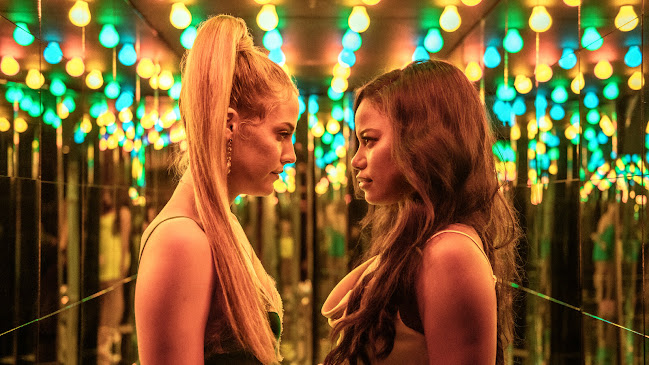
These two girls were perfectly cast. Like, disturbingly perfect. I finally got around to watching Zola. It’s been on my watch list for quite some time now.
Zola is based on a real story first told in a viral Twitter thread, following a Hooters waitress who impulsively joins a stripper she barely knows on a trip to Tampa to dance. What unfolds over a chaotic 48-hour period is a descent into manipulation, exploitation, and danger, told in a way that mirrors the fragmented, unsettling nature of its internet origins.
From the moment the film starts, you can tell Zola knows what it is and what it isn’t. I love adventure films, the kind that lure you in with movement and novelty, then quietly reveal that what you’re actually watching is danger unfolding in real time. That’s what pulled me toward this film, along with its very specific, very intentional storytelling style.
This isn’t a conventional narrative. It’s highly stylized, exaggerated, fragmented, and self-aware, because it’s based on a real story that was explained online first, then translated into cinema. The lighting is neon and artificial. The cuts are abrupt. Nothing is meant to feel smooth or safe. The film mimics the emotional whiplash of the original thread, funny one second, horrifying the next.
Zola herself is calm, observant, almost detached. She’s not shocked by what’s happening, she’s narrating it like someone who already knows how this ends. That emotional distance is what anchors the film. She’s not asking for sympathy. She’s reporting.
Stefani, on the other hand, is chaos incarnate. Validation-hungry, delusional, reckless. Not a villain, not a victim in the traditional sense, just profoundly unmoored. Watching her spiral is uncomfortable because we’ve all seen some version of her online. Or, if we’re honest, inside ourselves at some point.
There is one scene I genuinely struggled with, the strippers praying for Jesus to give them all sorts of absurd and inappropriate things.
It’s played for comedic relief, but as a Muslim who deeply loves and respects Jesus, it felt disrespectful in a way that wasn’t clever or insightful, just cheap.
This kind of scene pops up in films a lot, religion flattened into irony, spirituality treated like a prop. Constantly taking Jesus name in Vain. I’m really sick of it.
What stood out to me wasn’t just the scene itself, but how often this kind of thing slides by without much outrage. This scene almost ruined the film for me.
It made one thing clear: the writer isn’t really respectful when it comes to religion. And It shows.
What made this movie extra surreal for me is that it was shot right here. Tampa Bay isn’t a vague Southern backdrop to me, it’s home-adjacent. I recognized so many places it almost pulled me out of the story, except it also made it funnier and more unsettling at the same time.
The giant, dumb Confederate flag off I-75, the one I unfortunately know all too well, pops up like a visual scream: Yes. You are in the South. Because how else were the filmmakers supposed to make that obvious?
Clearwater Beach. Seminole. St. Pete Beach. Treasure Island. I immediately recognized the Wyndham Grand Clearwater Beach Resort, I’ve been there with my husband and daughter. Seeing it framed inside this story felt… wrong in a way only familiarity can feel wrong hehe.
The Sunshine Skyway Bridge, of course, because no Tampa Bay–set film can resist it. Motels I pass on Nebraska Avenue. Even the massive cross at New Life Tabernacle in Seffner, which I pass all the time, yes, I live out in Seffner which is the boondocks away from the city, lol.
The film ends abruptly, mirroring the way the original Twitter thread fractured and cut off. Zola, Stefani, X, and Derrek drive back to Detroit. The friendship is over. Zola ignores Stefani’s attempts to reconcile. The bond is broken. Cut to black.
From a storytelling perspective, it works. From a real-life perspective, it feels unfinished.What the film doesn’t fully explore is the aftermath. In real life, the man who inspired the pimp character was eventually arrested and sentenced to 16 years in prison.
The woman behind Zola played a role in bringing that case forward.
This wasn’t just a wild weekend story. It was a warning about sexual trafficking, coercion, and how quickly “adventure” can turn into entrapment.Zola herself has said that
the story is a cautionary tale about sex trafficking. Be careful who you trust. Be careful what you walk into. The internet might frame it as entertainment, but the consequences are real.
I actually enjoyed this film. A lot. It made me laugh. It made me uncomfortable. It was a wild ride that brought out of a bunch of emotions.
Zola doesn’t exist to comfort you. It exists to show how stories mutate online, how trauma becomes spectacle, and how survival sometimes looks like emotional detachment rather than triumph.
It’s messy.
It’s fragmented.
And it stays with you longer than you expect.
 Honestly, Vanessa