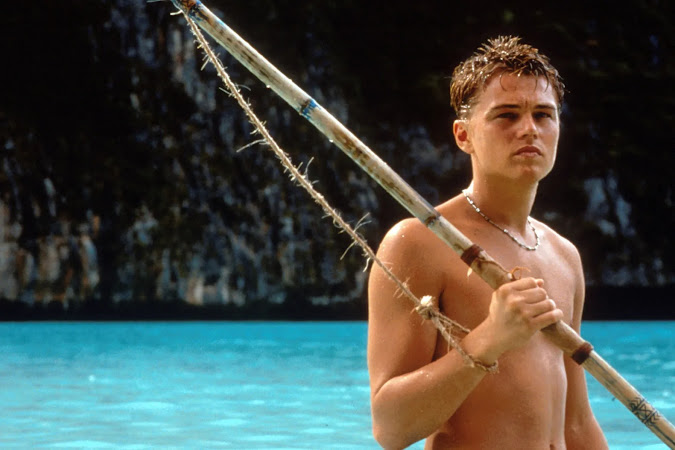

The Beach follows Richard, a young American backpacker traveling through Thailand who stumbles upon a secret island community living off the grid, untouched by tourists, money, or modern life.
What begins as a dream of freedom and belonging slowly reveals itself to be something far darker, a closed system where idealism, denial, and fear quietly replace morality.
So this is a film I tend to rewatch from time to time as it’s one of my favorites from the 2000s.
First off, I really love the message behind it. The film is about escape. About disappearing into some untouched corner of the world where money doesn’t matter, rules dissolve, and life becomes sun and salt and simplicity.
I think a lot of us did. Especially if we first watched it young, restless, romanticizing the idea that geography could fix what was broken inside us.
Rewatching it now in my thirties, The Beach feels less like a fantasy and more like a warning.
Richard isn’t searching for paradise. He’s running. And the island doesn’t save him, it just gives his emptiness better lighting.
The film seduces you on purpose. Thailand is drenched in beauty, youth, movement. Everything feels loose and alive at first. You can almost smell the ocean and feel the sweat. The early part of the film understands desire, the desire to belong, to disappear, to feel special for having discovered something others haven’t.
That’s the hook.
But what The Beach gets disturbingly right is that utopias don’t collapse loudly. They rot quietly. Slowly. Politely. With smiles.
The community on the island doesn’t feel evil at first. It feels reasonable. Structured. Organized. There are rules, yes! but they’re framed as necessary. For harmony. For survival. For the greater good. Everyone agrees because everyone wants the dream to work.
And that’s where the film becomes uncomfortable in the best way.
Because the real horror isn’t violence. It’s compliance.
It’s how quickly people stop questioning things once they’ve invested too much in the fantasy. How suffering becomes justified as long as it protects the illusion. How morality gets redefined when convenience is at stake.
People don’t turn monstrous overnight. They rationalize themselves there.
Leonardo DiCaprio plays Richard with exactly the right kind of emptiness. He’s not a hero. He’s not particularly deep. He’s reactive, curious, hungry for meaning but unwilling to do the work to build it. Which makes him the perfect candidate for disillusionment.
He doesn’t lose himself because the island corrupts him. He loses himself because he never really knew who he was to begin with.
And then, there’s that scene that I have to fast forward everytime. Ughhh.
Yes, it’s the sudden early-2000s video-game hallucination. The pixelated jungle run. The fake urgency. The aesthetic overkill. It’s the film briefly losing its nerve, afraid we won’t understand that Richard is unraveling unless it turns into a PlayStation cutscene.
The tragedy is that paranoia would have fit this story perfectly, just not in this form. Paranoia should have crept in through silence. Through isolation.
Through glances that linger too long. Through the realization that everyone is watching everyone else, pretending they’re not. The film didn’t need gimmicks like this. The descent was already there.
Still, despite that horrible sequence, The Beach holds up in the ways that matter.
It understands that paradise is never neutral. That every “perfect place” requires someone else to pay the price. That communities built on escape eventually demand sacrifice, usually from the weakest, the sickest, the most inconvenient.
And maybe the hardest truth the film offers is this:
You don’t find yourself by running away. You just bring yourself with you.
The Beach isn’t about Thailand. Or travelers. Or backpacker culture. It’s about the lie that there’s somewhere out there where you won’t have to face yourself.
There isn’t.
And that’s what makes the ending land. Not because it’s dramatic, but because it’s sobering. Richard survives, but the fantasy doesn’t. The illusion dissolves. What’s left is quieter. Smaller. More honest.
Freedom, it turns out, was never about the island.
It was about leaving the lie behind.
 Honestly, Vanessa