Inglourious Basterds is not a war film. It doesn’t pretend to be responsible, educational, or historically faithful. And that’s exactly why it works.
Quentin Tarantino isn’t interested in accuracy, he’s interested in emotional revenge. His favorite trope. This is a film about power, humiliation, storytelling, and what it feels like to watch evil finally lose control.
From the very first scene, the tone is set. The farmhouse opening is unbearable in the best way. It’s slow, polite, almost gentle, and yet suffocating.
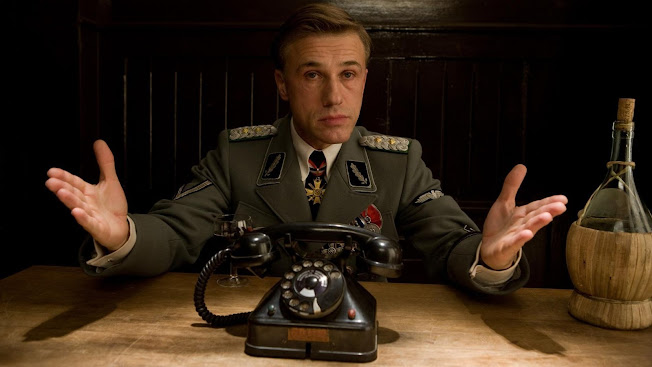
Christoph Waltz’s Hans Landa walks in smiling, talking about cows and milk, and by the time he leaves, the air feels poisoned. There’s no rush, no theatrics. Just language tightening like a noose. This is where you realize the real weapon in this film isn’t guns, it’s conversation.
Hans Landa is one of the most unsettling villains ever put on screen because he doesn’t rely on cruelty to establish dominance. He relies on intelligence. Awareness. Comfort. He enjoys being civil while destroying people, and Waltz plays him with such ease that it’s genuinely disturbing.
He doesn’t hunt out of hatred, he hunts because he’s good at it, and because he likes knowing more than everyone else in the room.
The strudel scene is where this becomes crystal clear. This is one of my favorite scenes in the history of cinema. Nothing happens, and yet everything happens. Landa insists Shosanna wait for the cream. He watches her eat. He smiles. He makes small talk.
The cake becomes psychological torture. He isn’t interrogating her, he’s performing certainty. He already knows who she is, or at least wants her to believe he does, and he lets that truth hover between them like a threat.
It’s dominance disguised as politeness, and it’s far more terrifying than any act of violence in the film. Waltz turns manners into menace, and it’s masterful.
Tarantino structures the film in chapters, which gives it a mythic, almost fairytale quality. Each section builds tension through language, accents, missteps, and cultural codes. The tavern scene is a perfect example.
A single hand gesture, something so small, becomes a death sentence. It’s excruciating to watch because you can feel the trap snapping shut long before it does. Tarantino understands suspense better than most directors working today, and he’s not afraid to let scenes breathe until the discomfort becomes unbearable.
Shosanna Dreyfus is the emotional core of the film. While the Basterds operate with exaggerated, almost cartoonish brutality, Shosanna’s revenge is quieter, colder, and far more intimate. Her weapon isn’t a gun, it’s cinema itself.
Tarantino turns the movie theater into a literal site of resistance, and it’s impossible not to read this as a love letter to film. Stories matter. Images matter. Sometimes they burn things down.
Brad Pitt’s Lt. Aldo Raine exists in a heightened, almost absurd register, and that’s intentional. The Basterds aren’t meant to be moral heroes. They’re violent, grotesque, and theatrical. Tarantino doesn’t clean them up or pretend their actions are noble.
Instead, he asks an uncomfortable question: when the enemy is built on terror, is terror an acceptable response? The film never gives a neat answer, and it doesn’t need to.
The most controversial choice, rewriting history, is also the most liberating. Tarantino allows cinema to do what reality couldn’t.
He gives us a fantasy where the architects of genocide are humiliated, trapped, and erased in flames and celluloid. It’s not subtle, it’s not respectful, and it’s not meant to be. It’s catharsis. It’s rage turned into art. It’s the fantasy of justice when justice never came.
Inglourious Basterds is indulgent, cruel, funny, and deeply cinematic. It’s a film about language as power, performance as violence, and storytelling as resistance.
Tarantino isn’t teaching history, he’s rewriting it for emotional survival. And when the credits roll, when Pitt delivers that final grin, it feels earned.
It’s messy. It’s provocative. It’s unapologetic.
And it just might be his masterpiece.
 Honestly, Vanessa