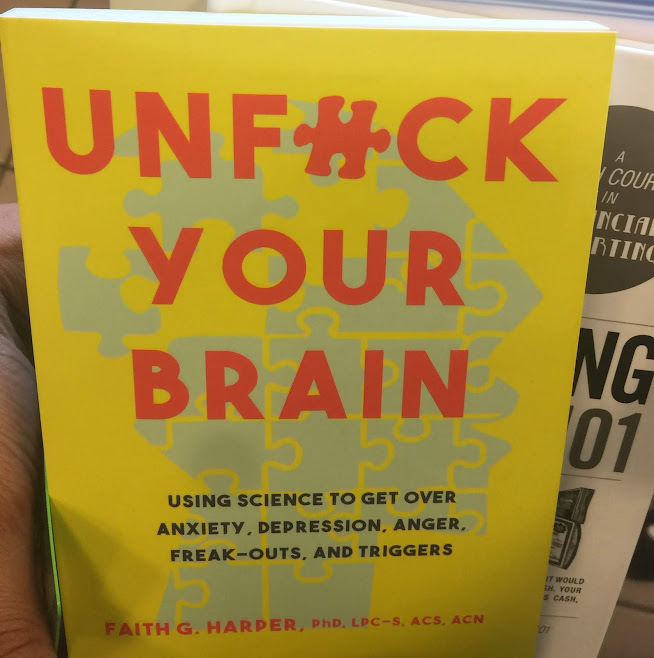
Honestly I’m really in my self-help books era right now. I’m craving anything that helps me understand my mind, my patterns, my healing, and the way my past still echoes through my present. What struck me most is how compassionate the book is. It doesn’t treat you like you’re broken or weak.
Unfck Your Brain isn’t just a catchy title even though it made me chuckle when I laid my eyes on the book cover, it’s meant to be ironic because at first glance, the title alone makes it seem like your brain is broken, defective, or just messed up.
But after reading a few chapter, the book is teaching you that your brain isn’t broken at all. It’s doing exactly what it learned to do. It’s following patterns that once kept you safe, even if those patterns don’t serve you anymore.
So if you learned to anticipate danger over time, you become hypervigilant. If you learned you weren’t safe unless you pleased people, you became a perfectionist and a people pleaser. If you learned the world could flip on you at any moment, you became anxious and highly paranoid even when nothing was wrong.
These aren’t personality flaws. They’re learned responses.The power comes from understanding that if the brain learned these patterns, it can also unlearn them.
What I really love about this book is that it doesn’t try to push toxic positivity which I loathe. It doesn’t tell you that choosing happy thoughts will magically erase your trauma. Instead, it explains the science of how thoughts create emotional patterns in the body.You don’t choose your first thought, that’s a neural reflex.
But you can choose the next one. And the next one. Healing is not about forcing yourself into a new mindset overnight. It’s about slowly introducing thoughts that feel believable, neutral, and safe enough for your nervous system to accept.
It also explains why logic doesn’t always override fear, why you can know something isn’t a threat and still feel threatened, why you repeat painful patterns even when you see them happening in real time. It shows you that being “self-aware” isn’t enough; what you really need is a new relationship with your own mind.
Here are some teachings that stand out in the book for me. The thought ladder is not replacing negative thoughts with positive ones, but building a bridge between them using neutral, believable thoughts your body won’t reject.
For example, instead of jumping from “I’m failing” to “I’m amazing and thriving,” which our brain will immediately roll its eyes at lol instead we can start with “Hmm it’s possible that I’m not seeing the bigger picture”.
Most of us also carry unspoken expectations about how others should behave to make us feel safe or valued so we must rewrite our manuals for people. Identifying those invisible rules breaks the cycle of disappointment.
For example, here’s one: “If he loves me, he should text back right away.” or maybe he’s busy doing something important? or “My husband should automatically know what I need without me asking.” or maybe you should communicate your needs to him because people are not mind readers. We just need to take a step back to see our expectations are realistic and practical.
Allowing emotional discomfort instead of avoiding it is key. Healing isn’t about feeling better immediately. It’s about becoming someone who can sit with uncomfortable emotions without being consumed by them.
For example, feeling triggered by something from our past and instead of spiraling into avoidance or dissociation, instead we can just remind ourselves that the emotion is old, not current, and let it rise and fall like a wave.
You don’t have to become a new version of yourself in order to heal. Healing is really about returning to yourself. It’s about uncovering the parts of you that were buried under trauma responses, fear conditioning, overthinking, and all the armor you had to build to survive.
Unfck Your Brain won’t heal you in one read. But it will give you the language to understand what’s happening inside you and the permission to believe that none of your patterns were random or shameful. They were just simply learned coping skills.
 Honestly, Vanessa