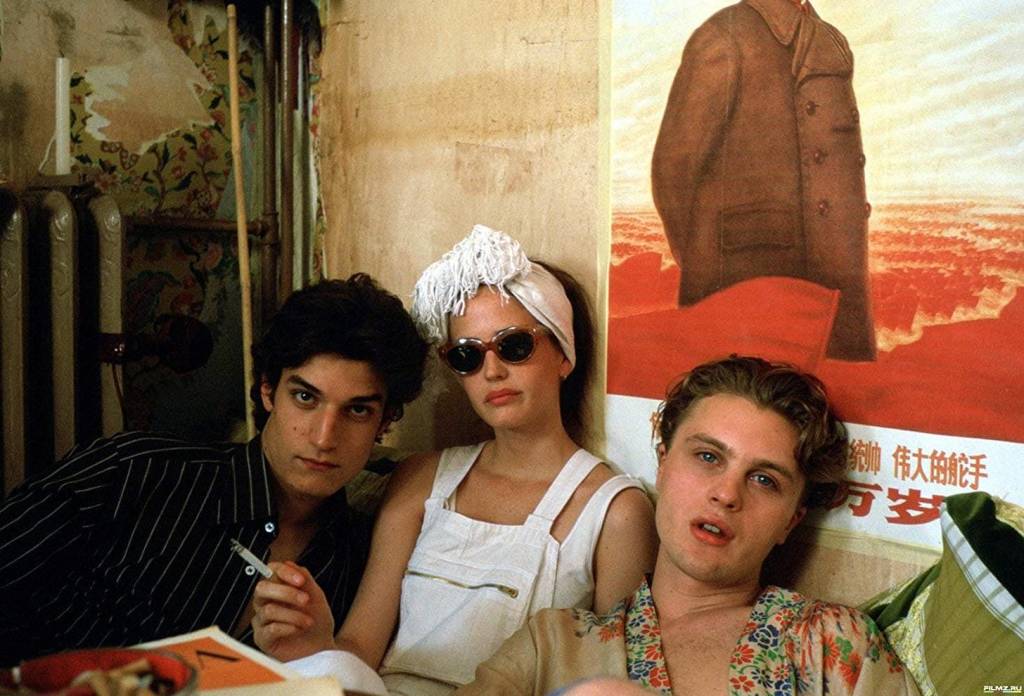
Synopsis: A young American studying in Paris in 1968 strikes up a friendship with a French brother and sister. Set against the background of the ‘68 Paris student riots.
I’ve always been deeply drawn to French cinema even as a child, and honestly I’m not a plot-driven viewer, I’m an atmosphere, psychology, and emotion-driven one. And that’s exactly what French films excel at. They slow everything down just enough for you to actually feel the moment… the way light hits a window, the sound of a record spinning, a lingering glance, the tension between two people who don’t fully understand themselves yet.
French cinema is visibly, unmistakably different from American cinema. It’s slow on purpose as the camera will linger on details because the details are the story. It’s steamy and sensual without being cheap where nudity feels artistic, not exploitative.
It’s philosophical,with conversations that aren’t filler but existential. It’s honest in a way few industries allow: messy emotions, flawed characters, moral ambiguity. It’s atmospheric. Shots of windows, rain, bedsheets, skin, sunlight.
And it’s deeply psychological, focusing more on how people think than what they do. I’ve been drawn to French cinema since I was a young child, long before I understood why it resonated with me so deeply.
That’s why The Dreamers resonates with me so much. It has that hazy, slow-burning, intimate quality that I adore, a film that feels less like you’re watching it and more like you’re drifting through someone’s private memories. T
he entire movie takes place in private spaces like in apartments, bedrooms, bathtubs where the characters create their own universe separate from the outside world. The intimacy is emotional, not just physical.
At the heart of The Dreamers are three characters whose chemistry is so intense and intimate that the entire film feels like you’re peering into someone’s private world. Isabelle is the magnetic, film-obsessed twin sister whose charm, unpredictability, and theatrical personality pull everyone into her world.
Theo is her passionate, politically rebellious brother, intense, opinionated, and constantly pushing boundaries.
Matthew is the American exchange student who becomes drawn into their universe, serving as both an outsider and a mirror to their chaotic dynamic.
The 1968 protests which is the backdrop of the film is not a plot device, but a metaphor. The outside world is demanding change, while inside their apartment, the characters are avoiding it.
The dynamic of the trio is interesting. The very strange codependency, identity formation, seduction, emotional testing, and blurred boundaries. It’s not meant to be “healthy.” It’s meant to show how young adulthood can become an illogical dream of longing, rebellion, and self-discovery.
Isabelle and Theo meet Matthew at a protest and, after hanging out with him a few times, casually invite him to move in with them. It’s so French. Meanwhile the American in him is like, “What? I’m a total stranger,” which makes the moment even funnier.
I’m going to share my thoughts and the memorable scenes that stood out to me.
One of the things I adore about Isabelle in The Dreamers is when she slips into iconic roles and acts them out, not to impress anyone, but because the movies live inside her the way they live inside me. It makes her feel multidimensional, creative, and emotionally alive, like someone who doesn’t just watch films but inhabits them.
Matthew Watching the Twins Sleep. A quiet, voyeuristic moment that exposes the emotional hierarchy inside the trio. It’s shocking, tender, unsettling, and psychologically loaded, everything The Dreamers does best.
Fun fact. The moment when Isabelle’s hair briefly catches on fire right before she gives Matthew a goodnight kiss wasn’t actually part of the script. It was a completely accidental, unscripted moment that the actors both handled so naturally that the director felt like he just had to keep it in and honestly, it fits the movie very well to the point where it looks intentional.
The Heated Debates about Films, Politics and Music between Theo and Matthew are some of my favorite moments, passionate, dramatic, borderline ridiculous, and so perfectly nerdy. It’s two passionate people arguing like the fate of the world depends on whose interpretation is right, which feels both hilarious and deeply relatable.
The Louvre Running Scene (Recreating Bande à Part). This is one of the most iconic moments, Matthew gets the answer right when Isabelle quizzes him on which film they’re reenacting as she fights with her brother, and that’s basically his initiation into their trio. Matthew risks getting deported as they illegally sprint through the Louvre together, recreating the scene like true cinephiles, and when they finish, Isabelle and Theo chant “gobble gobble, one of us,” officially welcoming him into their little world. It’s the moment he stops being an outsider and becomes part of their cinematic universe.
The Look and Feel of it. The French New Wave influence is everywhere from the vintage posters, messy bookshelves, classical + rock soundtrack, to the bathwater scenes, natural skin, natural lighting, natural emotion. It’s indulgent, beautiful, and artistic without trying too hard.
The moments when Matthew feels uncomfortable are the moments we feel it too. Whenever Theo and Isabelle cross lines that siblings should never cross, the film becomes genuinely unsettling and shocking and that discomfort is intentional. It really forces us to see things from Matthew’s perspective and it’s truly bizarre to him.
The scene where they run out of money and they’re starving. Theo goes out to ravage some food and he comes back with a bunch of junk and a very ripe banana. Matthew splits the banana in this clever little way with his finger, clean, precise, and almost ritualistic so each of them gets an equal share. That tiny gesture feels so tender and symbolic, showing how close they’ve become and how much they rely on each other. It’s such a small moment, but you can really see the innocence and sweetness here.
The Iconic Bath Scene. A stunning example of how the film uses silence and closeness to build emotional tension. It’s sensual but not pornographic, soft but charged, pure French cinematic intimacy that says everything without needing words. And that shot of all three of them in the bathtub, captured through the mirrors, is absolutely iconic, a visual that perfectly encapsulates their tangled, intimate universe.
One very important thing that I’ve noticed about Matthew is that he’s constantly trying to pull Isabelle and Theo back into reality and change, while the siblings would rather stay in their fantasy world in hiding. He becomes the grounding force in their trio, the one who sees the outside world clearly while they retreat deeper into their own private universe of intimacy and escapism. He wants them to break out of their codependency and help them become healthier versions of themselves, even if they resist it hard.
The Gas Scene After the Protest Breaks Into Their World. The outside world finally crashes into their bubble when the police throw a tear gas canister through the window during the student riots. It’s the moment their fantasy life ends, suddenly they can’t hide from reality anymore. The protest, the chaos, the adult world they’ve been avoiding becomes impossible to ignore. It’s emotional, jarring, and feels like the exact point where the dream ends and adulthood begins.
In the end, they go their separate ways. Matthew wants to protest peacefully, while Isabelle and Theo run straight into the chaos, choosing the intensity and danger of the streets over Matthew’s quieter, more grounded approach. Matthew choosing peaceful protest while Isabelle and Theo run into the chaos and this reflects who they’ve been the entire film. Matthew is grounded, idealistic, and looking for meaning; the siblings are impulsive, emotional, and addicted to intensity. He wants structure, reason, and moral alignment. They want passion, disruption, and escapism.
I love movies that explore identity, desire, emotional patterns, inner conflict, aesthetics, and psychology which is basically the holy grail of French cinema. The Dreamers is a beautiful, intimate, emotionally messy exploration of youth, identity, and sensuality wrapped in the aesthetics of French New Wave cinema. It’s the kind of film that lingers in your mind because of the feelings it evokes, not the plot it tells.
 Honestly, Vanessa