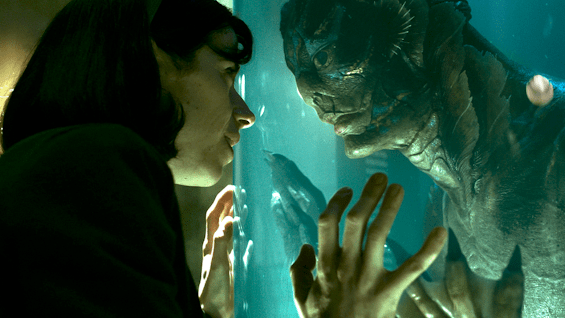
This isn’t a love story in the way people usually mean it.
It’s a story about who gets to be loved at all.
Guillermo del Toro doesn’t romanticize romance. He romanticizes the outcast. The quiet ones. The ones who don’t translate well. The ones the world keeps in the margins and then pretends not to see. This film isn’t asking whether the love makes sense, it’s asking why so much of the world’s cruelty does.
Elisa is mute. She doesn’t get speeches. She doesn’t get to argue her humanity out loud. And that’s the point. The world already decided she was expendable long before she fell in love with a creature locked in a government lab. She’s invisible at work, underestimated in life, reduced to utility. So when she sees something equally caged, equally misunderstood, she recognizes it instantly. Not as a curiosity, not as a project, but as kin.
People love to fixate on the “weirdness” of this film. The interspecies love. The fairy-tale elements. The sexuality. But the weirdest thing in this movie isn’t the creature. It’s the way power behaves. The way violence wears a uniform and calls itself order. The way a man like Strickland believes he’s righteous simply because the system handed him authority. He is not evil because he’s cruel, he’s cruel because he’s convinced he’s correct. And that’s always the most dangerous kind.
The creature, ironically, is the most emotionally literate presence in the room.
He listens. He responds. He mirrors. He doesn’t dominate or demand explanation. He doesn’t need Elisa to justify herself. He doesn’t require her to become more palatable, more normal, more legible. He meets her where she is, without language, without hierarchy. Their connection is quiet, physical, instinctive. It’s not sanitized. It’s not symbolic-only. It’s embodied. It’s desire without shame. Care without ownership.
That’s what unsettles people.
Because the film exposes something uncomfortable, we’re fine with violence as long as it looks familiar, but intimacy that breaks category rules makes us panic. We accept cages more easily than we accept tenderness that doesn’t follow the script.
What makes The Shape of Water ache instead of just charm is that it understands loneliness as something structural, not personal. Elisa isn’t lonely because she’s broken. She’s lonely because the world doesn’t make room for people like her. Same with Giles. Same with Zelda. Same with the creature. This is a film about chosen family formed in the cracks of a system that was never built for them.
There’s also grief in this movie. Grief for softness. Grief for a world where gentleness isn’t punished. The setting, the Cold War paranoia, the obsession with dominance and control, it all hums with fear. Fear of the other. Fear of losing power. Fear of anything that can’t be owned or weaponized. Against that backdrop, Elisa’s love isn’t naive, it’s radical.
She doesn’t try to save the creature because she’s pure or morally superior. She saves him because she refuses to accept a reality where survival requires becoming cruel. That choice costs her safety. It costs her certainty. It nearly costs her life.
And still, she chooses it.
The ending doesn’t offer clean closure. It offers surrender. Transformation. A return to something older than fear. It doesn’t say love fixes everything. It says love changes the terms. It reshapes what’s possible. It allows a different ending than the one power insists is inevitable.
This film isn’t about fantasy. It’s about refusing to harden.
And in a world that rewards hardness, that refusal feels almost obscene.
Which is exactly why it matters.
 Honestly, Vanessa